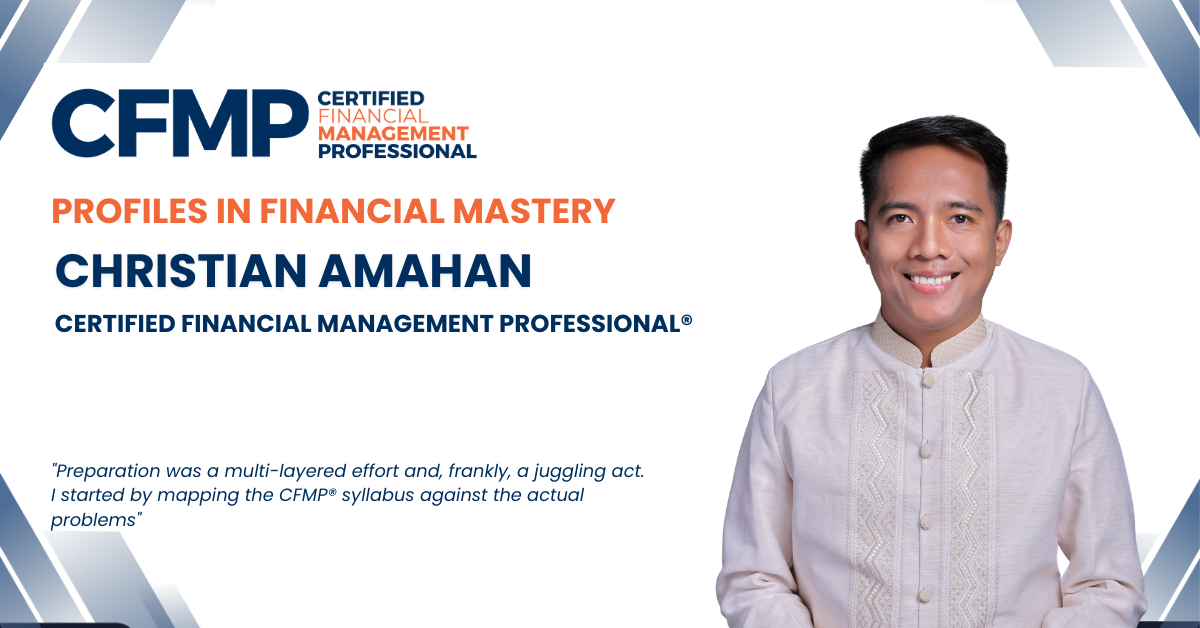
Profiles in Financial Mastery: Christian Amahan, CFMP®
Christian Amahan, CFMP®, is a dedicated financial professional whose expertise is formally recognized by his certification. This credential was pursued as a strategic response to the complex demands of his role within the public higher education sector, where he managed significant external research grants and navigated intricate fiscal audits.
The certification provides a structured and recognized validation of his technical acumen and professional judgment, equipping him to address high-stakes financial, legal, and operational decisions with greater authority and confidence.
His motivation stemmed from a direct need to fortify his recommendations in environments where fiscal decisions carry substantial implications. By earning this credential, he has systematically enhanced his ability to handle critical tasks—such as reconciling cash advances, ensuring proper accounting treatment for grants, and formulating persuasive responses to audit queries—with a reinforced, standards-based approach.
This certification thus represents more than an academic achievement; it is a practical tool that empowers him to advocate effectively for sound financial management and robust internal controls within his institution.
His Motivation to Pursue CFMP®
“To be honest, the motivation came from a mix of frustration and ambition. Early in my career at the SUC, I found myself repeatedly facing situations where decisions were being made about funds, projects, and procurement that had big implications—political, legal, and operational—but I didn’t always have the confidence that my technical knowledge and recommendations would carry the weight they needed to.
We were handling externally funded research projects (DOST-PCIEERD grants, for example), reconciling cash advances, and responding to COA queries that required not only correct accounting treatment but also persuasive, legally grounded explanations. I realized that experience alone wasn’t enough — I needed a structured, recognized credential that validated both my technical skills and my judgment.
Another big driver was the desire to bridge two worlds: the nitty-gritty of government accounting under the Government Accounting Manual (GAM) and the more strategic, forward-looking aspects of financial management—planning, risk assessment, performance measurement. The CFMP® appealed because it emphasized practical decision-making and strategic finance, not just bookkeeping.
I also wanted to set an example within the Finance and Management Services (FMS) team — to show younger accountants and administrative officers that continued professional growth is possible even within a government institution where day-to-day pressures are relentless. So, it was personal growth, professional credibility, and the desire to make a bigger impact at the university that pushed me to pursue the designation.”
How He Prepared and the Challenges He Faced
“Preparation was a multi-layered effort and, frankly, a juggling act. I started by mapping the CFMP® syllabus against the actual problems we handle at the SUC. That helped me see which topics were immediately relevant — public sector budgeting, cost allocation for projects, performance indicators, internal controls — and which ones required more conceptual study, like corporate finance frameworks and risk management models.
My study plan had three pillars: structured study material, applied practice at work, and peer discussion. Mornings before work and late evenings were reserved for reading — not long blocks, but consistent 45–60 minute sessions. I made heavy use of practice exams and case studies because CFMP® questions are often situational: they test judgement, not rote memory.
At work, I deliberately asked to be assigned to tasks that would let me apply what I’d just studied — for instance, I volunteered to draft the certification for externally funded projects and to take on consolidation work for the university’s obligation and liquidation reports. Applying the concepts immediately helped the learning stick.
The toughest challenge was time management. In the fiscal office of a SUC, timing is everything: budget calls, disbursement schedules, and COA inspections don’t wait for exam timetables. There were months when a major audit or a sudden on-site visit consumed my evenings, and study time vanished. I had to get comfortable with incremental progress — 20 minutes of targeted review is better than nothing — and negotiate realistic study windows with my supervisors by explaining that the certification would be an asset to the unit.
Another big challenge was mindset. Government accounting often requires very conservative, rule-driven thinking, while some CFMP® topics ask you to weigh trade-offs and embrace ambiguity. Learning to be comfortable with “it depends” answers, and to justify recommendations with a mix of regulation (GAM/COA) and sound financial reasoning, was a humbling but crucial part of preparation. I also leaned on colleagues who had already taken similar certifications — their practical tips on exam tactics and how to translate concepts into our local context were invaluable.”
Benefits He Experienced After Earning CFMP®
“The change didn’t happen overnight, but it was noticeable. Professionally, the most immediate benefit was credibility. When I present budget proposals or recommend how to handle the liquidation of cash advances for a DOST-funded project, colleagues and supervisors listen more carefully.
The credential signals that I’m not just familiar with the GAM and COA issuances, but that I can also interpret them in light of broader financial management principles. That has made it easier to lead inter-office consultations, chair budget review sessions, and represent the university in multi-agency meetings.”